
Since the Unified Behavior Model went public (preprint 7/8/2025), the same critiques keep returning. Most aren’t objections to the model — they’re misconceptions about what a foundational framework is.
👋 Hey, Martin Grunburg — U at the end. Not the FDIC chair. Ha! 😄 Author of the Habit Factor® trilogy, creator of the Unified Behavior Model™ (UBM), and host of the Habits 2 Goals podcast.
Start here
Behavioral science has spent nearly 150 years producing complications, distinctions, and competing frameworks.
That’s all important work. It just isn’t upstream education. It’s downstream therapy.
Basic Behavior Literacy — not behavioral, not academic — is something different. It’s the elemental foundation that has eluded the field since day one.
BBL is something anyone can learn, apply, and teach. No need to wait until something feels off, broken, or wrong.
Simple enough for any adolescent. Rigorous enough to withstand 400+ days — and counting — without a single scientific refutation.
Four elements. Just four pieces that explain the entire behavioral spectrum.
Let’s go.
Lesson 1 — Two Nouns. Distinct. Observable.
A human being is a noun. A person. Biology. DNA.
Behavior is also a noun. An observable event. Distinct and separate from the person performing it.
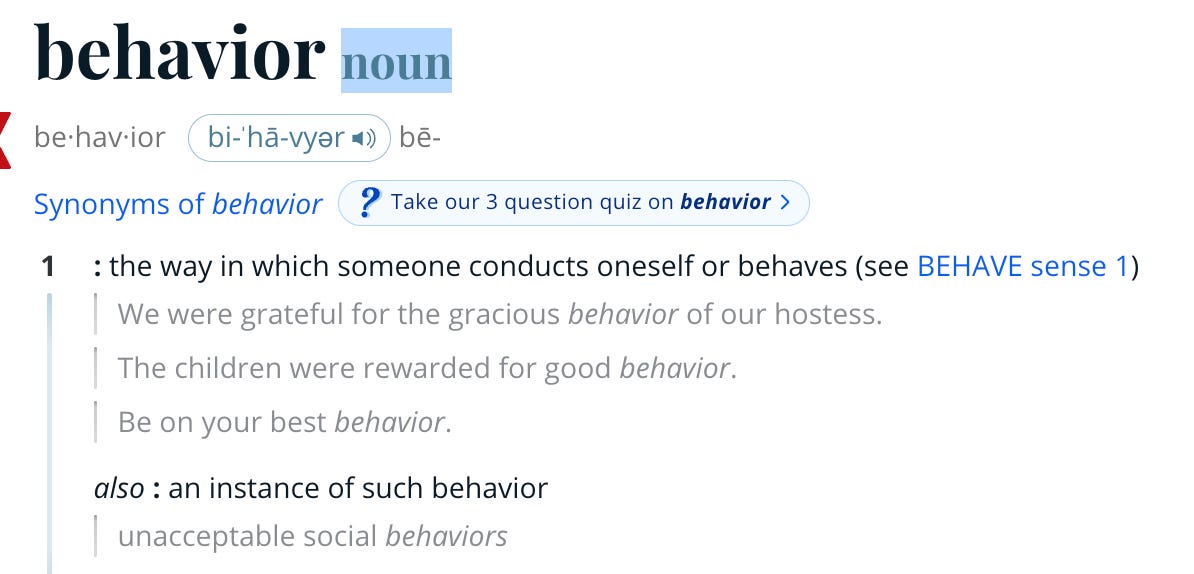
The surprising thing is this distinction has appeared to elude most of the field for nearly 150 years.
Conflating the two is a category error that creates enormous fog — and real damage.
“You are NOT your behavior. You are RESPONSIBLE for it. But you are not the act.”
You are the vehicle behavior is delivered from. Behavior is the route. Your body is the car you can never exit.
Biology behaves — but biology isn’t the behavior.
This matters because behavior is separate, selectable, and steerable.
I can go for a run or sit on the couch. Either way — behavior is observable, distinct, and mine. That separateness is what makes behavior modelable. And changeable.
Lesson 2 — Four Elements. Not Five. Not Eleven.
Once behavior is recognized as distinct — separate — the next question is simple: what influences it in the moment and shapes it over time?
To model behavior — not the person — we begin with, you guessed it:
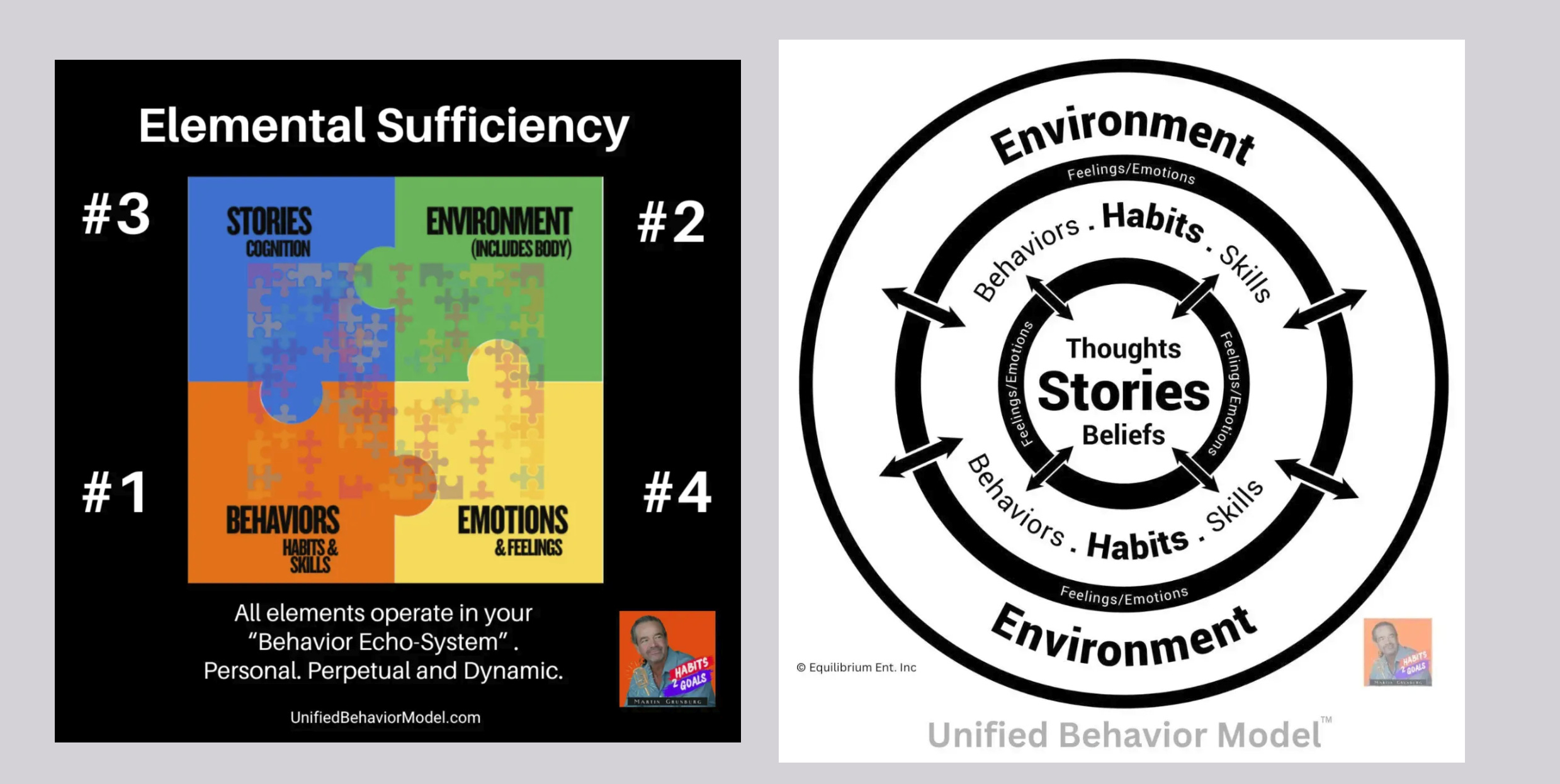
Element 1 — BEHAVIORS / Habits / Skills: Actions in the moment, including inaction, and those shaped over time.
Element 2 — Environment: The place you behave in — and your body. The body is the most proximate behavioral stimulus. A toothache, poor sleep, hunger — all may change how you think, feel, and act. Behaviorally speaking, a toothache and a construction site outside your window belong in the same category. Both are stimuli.
Element 3 — Cognition / Stories: How you think. When it comes to behavior, thinking happens predominantly in the form of narratives — stories — to plan, predict, and explain events and circumstances. Einstein smoked. Not logical. Pure story: “it helps me think.” Stories drive behavior constantly — it’s precisely why marketing works.
Element 4 — Emotions and Feelings: We are sentient beings. Feelings are variable conduits — relays of information and energy throughout the system.
Key idea: think of feelings and emotions as SIGNALS. Not commands.
What’s worth understanding: concepts like motivation, willpower, discipline, and the “mind” are not elemental. Each arises from — or can be subsumed into — some combination of the four elements.
Motivation? Could be a story (”I don’t want to do this”), a feeling (low energy), or an environmental trigger (blood sugar crash). It’s a compound — not a primitive.
This is precisely why these are the four elements. It’s why the model is elementally sufficient. And it’s why — despite a year-long open global challenge, despite the world’s top frontier AI systems attempting — no fifth element has been produced.
Four. Nothing outside them. Nothing left out.
Lesson 3 — The Behavior Echo-System
The four elements don’t operate in a straight line.
No flowchart. No staged sequence. No unidirectional arrows. No steps, no preset order.
The key insight: the four elements interrelate within what’s called the Behavior Echo-System — not ecosystem. Echo, as in reverberation. You and I can share a room, a classroom, even a culture. We cannot share a Behavior Echo-System. Even identical twins cannot — same genome, same household, entirely different systems.
Every BES has three properties:
Personal — only you will ever experience yours.
Perpetual — your behaviors operate within it until you die.
Dynamic — sometimes you feel, then think, then act. Sometimes you act without thinking at all. No preset sequence. No guaranteed order.
A story may influence a feeling. A feeling may drive a behavior. A behavior may alter your environment. Your environment may shift your cognition entirely. Omnidirectional. Always moving. Always yours.
This is the closed, causal system behavioral science has sought since its inception.
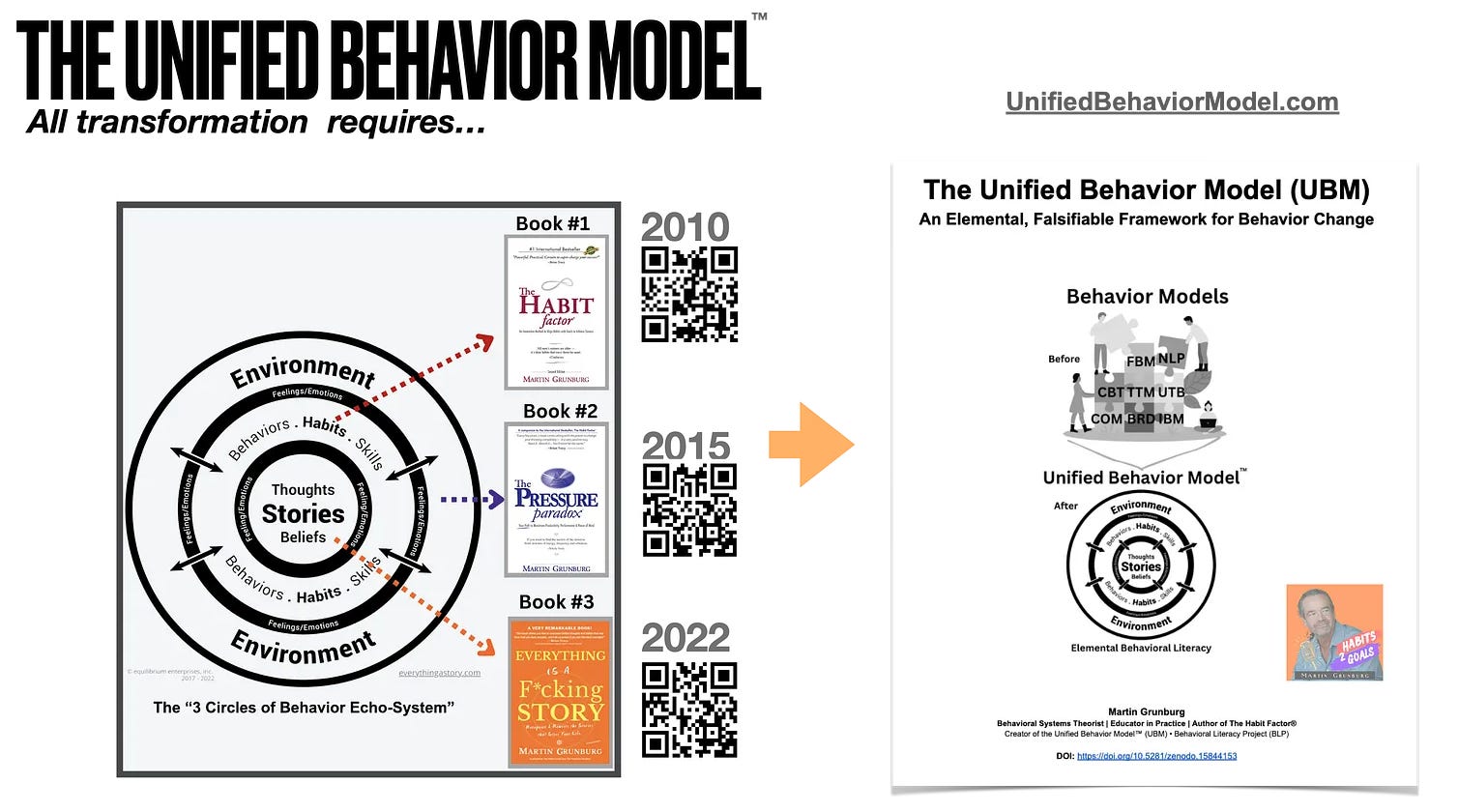
There she be. ☝️
Lesson 4 — P.A.R.R.
The short version: P.A.R.R. — Plan, Act, Record, Reassess — is how you intentionally move your Behavior Echo-System from where you currently ARE to where you want to BE/GO.
It’s how you create alignment across all four elements in service of a goal.
It mirrors the scientific method. It makes you the behavioral scientist of your own life.
For the full tutorial — including five onboarding emails and a walkthrough from the lovely Jen G — download the free template:
👉 thehabitfactor.com/templates
The Bottom Line
In roughly 30 minutes you’ve covered four foundational concepts that constitute Basic Behavior Literacy.
We say this with genuine respect for the experts — they’ve done important, often brilliant work. Their specialty has been complications, distinctions, and depth within specific domains. That work matters.
However — without a shared paradigm, framework, or ontology — without coherence — the field has remained fragmented. That fragmentation is precisely the self-described “crisis of incoherence” that has plagued behavioral science since its inception.
How and Why UBM Changes the Game
What’s been missing is upstream education. Simple, elemental, accessible — available long before anything feels broken.
This is not therapy. UBM is upstream education for the roughly 95% of people with a sound mind, body, and goals — who deserve a reliable map and have never had one.
George Miller called for it in 1969: “Give psychology away to the people.”
Fifty-seven years later — here it is.
Why should anyone wait until something feels broken to learn how their own behavior works?
Do this today
Think about a habit you’ve been struggling with.
Instead of asking: “What’s wrong with me?” — that’s the person, the noun, the biology —
Ask: which element is out of alignment?
Environment? Stories? Emotions? Behavior itself? Which lever can you adjust to move toward the habit or behavior that serves your most important goal?
Test it. You are the behavior scientist of your life.
That single reframe is the beginning of Basic Behavior Literacy.
Download the free template and run your first P.A.R.R. cycle:
👉 thehabitfactor.com/templates
Is this fun or what?
You’re learning — genuinely learning — how your own behavior works. That’s not nothing. That’s everything.
Now imagine mapping your own Behavior Echo-System in real time — running a live audit and walking away with a framework you’ll use for the rest of your life. 🤫
The Habits & Goals Master Class is the answer.
Twenty years of research, coaching, and iteration — delivered in a single morning.
Workshop 2 begins Tuesday, 9/15
🌐 UnifiedBehaviorModel.com — free white paper
📚 The Habit Factor® · The Pressure Paradox™ · EVERYTHING
🎙️ Habits 2 Goals Podcast
📄 Free habit tracking template